Waste Is Not Feedstock: Where the Plastic-Recycling Business Actually Begins

The world has no shortage of discarded plastic. The industrial challenge is turning it into material that manufacturers can use and buy with confidence.

By Ovanes Oganisian — October 26, 2026

The world produces more than 400 million tonnes of plastic a year and consumes roughly half a billion tonnes under broader definitions. Only about 9 percent of plastic waste is ultimately recycled. The gap is not simply a moral failure. It is an industrial one.

UNEP estimates that global plastic consumption reached approximately 516 million tonnes in 2025. PlasticsEurope, using a narrower production definition that excludes several fibre and non-product applications, counted 430.9 million tonnes in 2024. In round numbers, the world now uses between 1.2 million and 1.4 million tonnes of plastic a day.

The best complete global material-flow estimate found that 353 million tonnes of plastic waste were generated in 2019. Around 9 percent was ultimately recycled. Approximately 174 million tonnes went to sanitary landfill, 67 million tonnes were incinerated and 79 million tonnes were mismanaged, openly burned or leaked into the environment.

The accumulated stock is much larger. UNEP estimates that 9.2 billion tonnes of plastic were produced between 1950 and 2017. Around 7 billion tonnes had already become waste. Approximately 5.3 billion tonnes had been discarded into landfills or the wider environment.

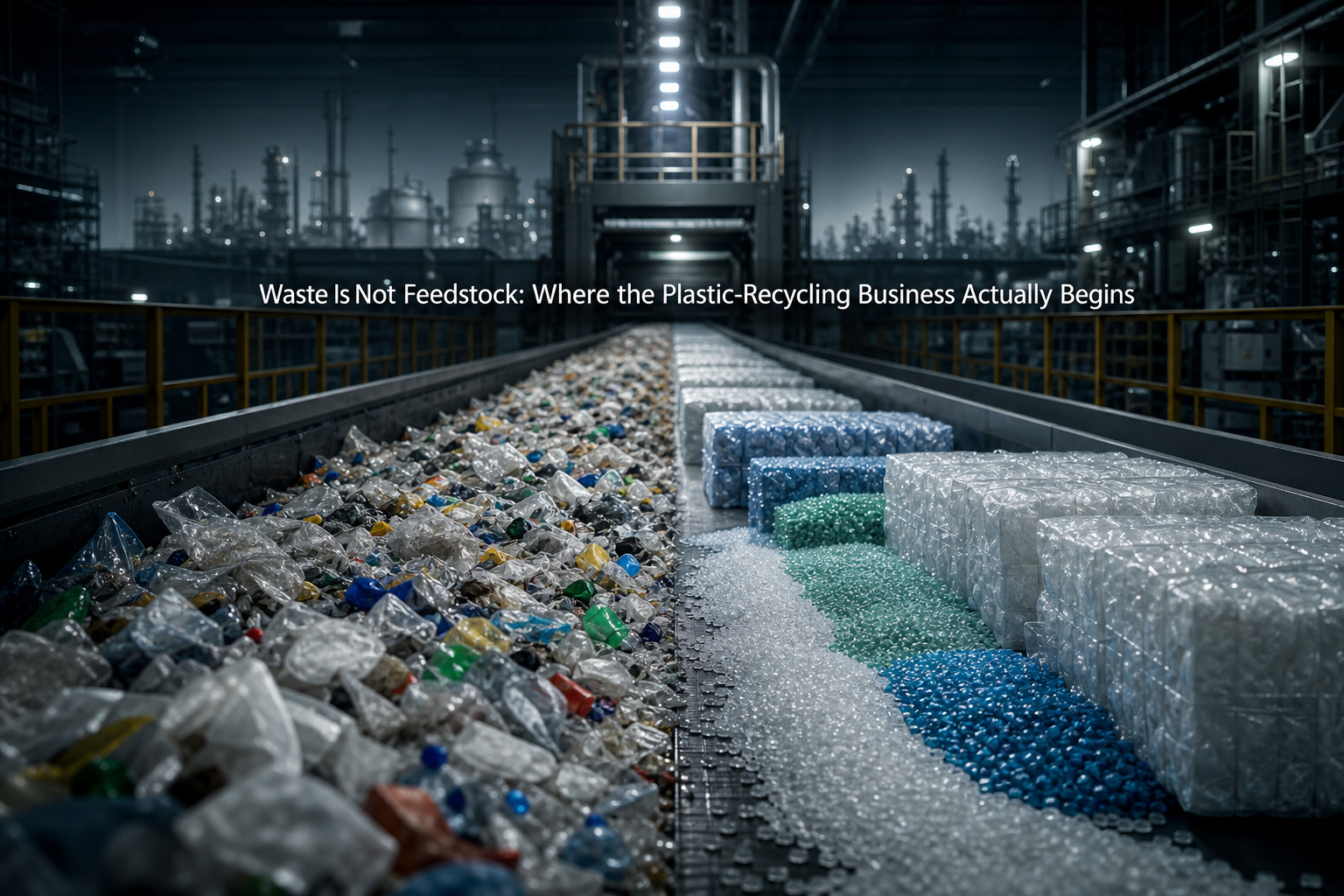
These numbers suggest an enormous supply of material for recycling. In practice, most discarded plastic is not immediately usable industrial feedstock. It is mixed, contaminated, geographically dispersed and often worth less than the cost of collecting, sorting and processing it.

This is where the plastics-recycling business begins: with the difficult conversion of abundant waste into consistent material that a manufacturer can buy with confidence.

The Production Baseline: Almost 90 Percent Fossil

The scale of the challenge becomes clearer when we look at what is being produced, not only what is being discarded.

Global plastic production in 2024 was approximately 430.9 million tonnes:

Source of plasticProductionShare
Virgin fossil material387.0 million tonnes89.8%
Mechanically recycled plastic40.8 million tonnes9.5%
Bio-based material2.6 million tonnes0.6%
Chemically recycled material0.4 million tonnes0.1%
Captured-carbon materialLess than 0.1 million tonnesLess than 0.1%
Total430.9 million tonnes100%

The plastic economy therefore remains almost 90 percent dependent on virgin fossil resources. Recycled material represents a genuine industrial achievement, but it still supplies only about one-tenth of production.

The oil-versus-gas-versus-coal allocation is less settled. Petrochemical plants use mixed inputs, while feedstock, processing fuel and intermediate chemicals can have different origins. A 2025 material-flow study of 2022 production attributed approximately 145 million tonnes of plastic to petroleum, 29 million tonnes to natural gas, 159 million tonnes to coal and 22 million tonnes to coke and other fossil sources. The large coal attribution reflects China’s coal-based chemical industry as well as the study’s treatment of the upstream supply chain. It should not be read as a reactor-by-reactor measurement.

For the recycling business, the central fact is simpler: alternative feedstock remains small beside a mature fossil-based industry with enormous plants, established logistics and decades of process optimisation.

The Oil Connection

The petroleum share is large enough to place plastics firmly inside the global oil economy. The material-flow study attributed approximately 145 million tonnes of 2022 plastic production to petroleum-based supply chains.

As a scale comparison, 145 million tonnes of crude oil would equal just over one billion barrels at a rough conversion of 7.3 barrels per tonne, or around 2.9 million barrels a day. That is equivalent to approximately 4 percent of annual world crude production, 11 percent of OPEC production, or 7 percent of the wider OPEC+ group’s production at 2024 rates.

This is not a physical estimate of the barrels consumed to manufacture plastic. A tonne of petroleum-attributed plastic does not require exactly one tonne of crude. Refineries produce fuels and numerous chemical fractions together, and finished plastics also incorporate gas-derived inputs, additives, chlorine, oxygen and other materials.

A better direct measure comes from the International Energy Agency. It estimates that petrochemical feedstocks account for about 12 percent of global oil demand. That category is broader than plastic and also includes chemicals used in fertilisers, solvents, detergents and many other products. Plastics are nevertheless one of its largest components.

The connection is becoming more important. Road-fuel demand faces pressure from electric vehicles and improved efficiency, while petrochemical demand continues to grow. The IEA reported that the increase in global oil consumption between 2019 and 2024 came almost entirely from petrochemical feedstocks, whose demand rose by more than 12 percent over the period.

For recyclers, this creates a formidable competitor. Virgin resin comes from an established petrochemical system capable of producing consistent material in volumes measured in millions of tonnes. Recycling is therefore connected not only to waste policy, but also to the future structure of the oil industry.

The Gap Is Not Where Most People Think

The global system collected around 15 percent of plastic waste for recycling in 2019. Processing losses reduced the amount actually recycled to roughly 9 percent. On the OECD’s figures, only about 32 million tonnes of 353 million tonnes of waste returned successfully as recycled material.

The remaining gap is enormous. It cannot be treated as though every discarded tonne represents profitable feedstock. The addressable market becomes smaller at every stage:

353 million tonnes of annual waste
↓
Material that can be collected economically
↓
Material that can be separated by polymer and colour
↓
Material clean enough to process
↓
Recycled output meeting customer specifications
↓
Material sold under a dependable offtake contract

Each step is a commercial filter. A tonne of mixed municipal waste is not equivalent to a tonne of clean, sorted high-density polyethylene. The first can carry a disposal cost. The second can trade as an industrial commodity.

Recycling economics lie in the conversion between the two.

Why Collection Is Only the First Constraint

Collection matters, particularly in countries without reliable municipal waste systems. In developed markets, however, collection is often only the beginning of the problem.

A significant share of collected material can be rejected because it is contaminated, composed of several bonded materials or mixed with polymers that require different processing. A further share may be technically recyclable but unable to find a buyer at a price that covers sorting, cleaning and conversion.

The economics are driven by the spread between the cost of converting waste into specification-grade material and the price a manufacturer will pay for it. Hydrocarbon prices influence that spread, but so do polymer capacity, electricity, transport, local regulation, customer qualification and the balance between supply and demand. A low oil price can put recycled resin under pressure; it is not the only price driver.

The market has repeatedly shown that environmental value does not by itself pay the conversion cost. Someone must fund the collection and processing, or the recovered material must command a sufficient selling price.

The Quality and Routing Problem

Quality is one of the most underappreciated constraints.

A food-packaging manufacturer cannot accept recycled plastic carrying unsafe contaminants. An automotive supplier needs repeatable mechanical properties. A textile producer needs controlled colour and molecular characteristics. Mixed municipal plastic rarely meets these specifications without substantial sorting and processing.

This is why much mechanically recycled material moves into applications with less demanding specifications rather than returning to its original use. Mechanical recycling is usually the most efficient route for clean, separated streams. More difficult mixtures require another destination: specialised products, controlled energy recovery, disposal or thermal and chemical conversion.

Pilgrim Green, a circular-plastics infrastructure project in Slovakia with which MidLincoln is working, sits in this more difficult part of the map. Its proposed thermal-conversion route is aimed at mixed plastic streams that are poorly suited to ordinary mechanical recycling. The relevant commercial tests remain the same: dependable feedstock, plant uptime, output specification, regulatory treatment and a secure buyer for each recovered product.

Thermal conversion should not automatically be called closed-loop recycling. The classification depends on the process yield and what happens to the recovered output. Material returned to new chemical or plastic production has a different environmental and commercial profile from material ultimately burned as fuel.

The Offtake Problem

Even when a recycler produces usable material, the business depends on a buyer.

Offtake agreements are the backbone of a recycling project. Without a committed customer willing to purchase a defined volume at an agreed specification and pricing formula, the recycler remains exposed to commodity volatility, quality disputes and demand shocks.

This explains why strong recycling businesses often control several parts of the chain or build close relationships across it. They know where their waste comes from, understand how it must be processed and have identified the customer before expanding capacity.

A plant can be technically successful and commercially weak. Producing material is only half of the operating model. Selling every output, including lower-value fractions and residues, determines whether the system works as a business.

The Policy Backdrop

Policy is changing the economics.

The European Union’s Packaging and Packaging Waste Regulation establishes minimum recycled-content requirements for several categories of plastic packaging. The UK Plastic Packaging Tax applies to finished plastic packaging containing less than 30 percent recycled plastic. A growing number of US states have adopted extended-producer-responsibility systems that shift more of the collection and processing cost toward producers.

These measures create demand for recycled material by requiring recycled content, placing a cost on virgin-only packaging or making producers responsible for waste management. They cannot remove contamination or create a qualified product by themselves. They can change the price signal enough to make investment in collection, sorting and processing commercially possible.

The OECD projects that, without stronger policies, annual plastics use will reach 1.23 billion tonnes and annual plastic waste 1.01 billion tonnes by 2060. Only about 17 percent of waste would be recycled under that baseline. In the OECD’s Regional Action scenario, better waste systems, recycled-content support and taxes on plastics and packaging lift the global recycling rate to approximately 40 percent.

The gap between those outcomes depends on infrastructure, product design, enforcement and demand for recovered material. Technology is part of the answer; policy determines how widely it can be deployed.

What the Numbers Actually Say

The 9 percent recycling figure is often presented only as a scandal. It also describes the economics of the system.

Of the 353 million tonnes of waste generated in 2019, around 32 million tonnes became recycled material. The rest went to landfill, incineration, uncontrolled disposal or the environment. Technology exists to process more than 9 percent, but technical possibility is not the same as an economically reliable supply chain.

The production data reinforce the point. Recycled material supplied around 41 million tonnes of the 431 million tonnes produced in 2024. Mechanical recycling dominated. Chemically recycled material amounted to only about 0.4 million tonnes, while bio-based and captured-carbon materials together supplied less than 3 million tonnes.

The opportunity is real, but it is not distributed evenly across the waste stream. It is concentrated where material can be collected at a manageable cost, routed to the right process, converted to a stable specification and sold under a dependable commercial arrangement.

That fraction can grow substantially. Better product design can reduce mixed-material packaging. Digital identification can improve sorting. Recycled-content rules can support demand. Long-term collection and offtake contracts can make projects financeable. None of these measures makes every discarded tonne equally valuable.

The Business Begins at the Funnel

The plastic-recycling business begins with a funnel.

At the top is hundreds of millions of tonnes of annual waste. At the bottom is material that meets a customer’s specification and is sold under contract. The distance between the two is measured in logistics, contamination, sorting, conversion yield, quality control, regulation and customer relationships.

The companies that narrow that distance are building businesses rather than promising to solve the entire plastics crisis. Their work is nevertheless the mechanism by which the recycled share can become larger.

The same framework should be used to examine an operating mechanical recycler, a new sorting technology or a project such as Pilgrim Green. Start with the incoming material. Follow every tonne through the process. Measure the energy, losses and residues. Test each output against a real buyer’s specification. Then examine the contracts that hold the chain together.

The waste is abundant. Usable feedstock is scarce. The business begins with the conversion.

Current Opportunities and Consulting Offers

MidLincoln Portfolio Architecture

Venture Portfolio

Research · Fintech · AI · Infrastructure

A founder-led portfolio of operating and development-stage ventures spanning research, guided change, trade finance, blockchain infrastructure, applied AI, energy and financial intelligence.

Current FocusPortfolio structuring, strategic partnerships, revenue acceleration and selective external financing.
MidLincoln Opportunity

Prime Mining

Deep-Tech Blockchain Protocol

A deterministic prime-based blockchain architecture built around useful computation, cooperative verification, and post-quantum-oriented infrastructure.

Current FocusFrontier protocol opportunity. Public page frames the research, protocol path, raise logic, and investor fit.
MidLincoln Capital Architecture

Pilgrim Green

Circular Plastics Infrastructure · Slovakia

A commissioning-stage circular infrastructure project designed to convert difficult plastic-waste streams into recovered industrial products.

Current FocusCompletion financing, commercial commissioning, investor due diligence and preparation for wider European replication.