Conclusion: falling countries
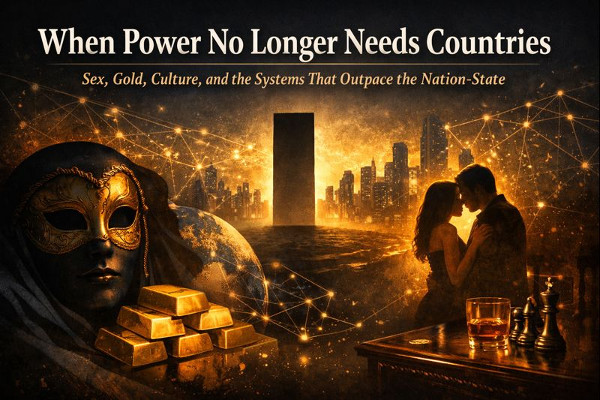
Countries do not disappear when borders are crossed or ideologies collapse. They weaken when the forces that organize human behavior slip beyond their reach. Intellect abstracts faster than institutions adapt. Desire continues to drive status, risk, and ambition regardless of moral frameworks. Value seeks permanence when trust in abstractions erodes. Power reorganizes itself around access rather than legitimacy. And the idea of progress survives through symbols — frontiers, technologies, images — even as collective direction fragments.
In this phase of disglobalisation, these forces no longer align naturally within national structures. Desire is global, value is mobile, power is networked, intellect is individualized, and aspiration is increasingly symbolic. Governments still legislate, but they no longer anchor meaning. They manage narratives while incentives flow elsewhere. What emerges is not collapse, but thinning — authority remains visible, yet its capacity to coordinate behavior steadily diminishes.
This is why falling countries rarely announce their decline. There is no singular rupture, no decisive defeat. Instead, systems continue to function, markets continue to price reality, and individuals adapt rationally to the incentives before them. States persist as form, but their role as engines of coordination weakens. Power does not overthrow them; it simply moves on.
The question, then, is not whether countries will survive. Many will. The question is whether they can realign human incentives — desire, value, abstraction, authority, and aspiration — faster than those incentives continue to reorganize themselves beyond borders. History suggests that when systems fail to do so, they are not destroyed. They are quietly outpaced.