The Mines Behind the Silk Road: Central Eurasia’s Gold Belt

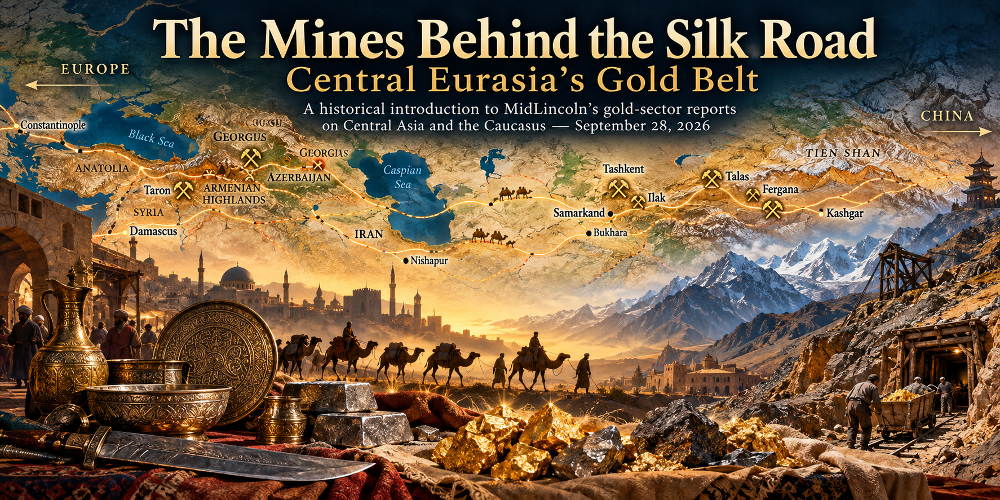
A historical introduction to MidLincoln’s gold-sector reports on Central Asia and the Caucasus — September 28, 2026

MidLincoln has published a companion set of modern gold-sector country reports for this essay. The reports cover Uzbekistan, Kazakhstan, Kyrgyzstan, Armenia, and a regional note on Tajikistan, Azerbaijan and Georgia. This blog is the historical and conceptual introduction to that research: it explains why the modern gold belt of Central Asia and the Caucasus should be read not as isolated national mining stories, but as the latest expression of a much older Eurasian mineral economy.

The Silk Road is usually drawn as a line.

At one end is China. At the other is Europe. Silk, porcelain and spices move west; gold and silver move east. Samarkand, Bukhara, Kashgar and the other cities of Central Asia appear mainly as stops along the way—dots on a map, waystations on a journey that begins and ends somewhere else.

It is an attractive picture. It is also, in an important sense, wrong.

The Silk Road was never a road. It was never one road, and it was never primarily about China or Europe. Between those two imagined endpoints lay an enormous economy that did not require either of them to justify its existence. Central Asia, Iran, the Caucasus, the Armenian highlands and Syria contained cities, mines, farms, workshops, markets and states with their own production and consumption. Their merchants traded with one another as much as with distant markets. Their economies produced things—metals, textiles, ceramics, weapons, jewellery, tools—that were consumed locally, regionally, and sometimes exported.

Gold and silver provide an unusually good way to see this.

A thousand years ago, some of the regions through which the Silk Road passed were already important mining districts. Gold, silver, copper, lead and other metals were extracted, processed, minted, worked into jewellery and luxury objects, and traded between cities. The caravan was only one part of the system.

The mine came before the caravan.
The Road Was Never One Road

There was never a single Silk Road.

Routes moved with wars, political alliances, taxation, climate and the rise and decline of cities. Some crossed the Tien Shan. Others passed through the Fergana Valley. Some ran south through Afghanistan and Iran. Others crossed the Caspian and Caucasus. Still others connected Central Asia with the Eurasian steppe.

Nor did merchants normally carry cargo all the way from China to the Mediterranean.

Goods changed hands.

A merchant might operate between China and Central Asia. Another between Central Asia and Iran. Another connected Iran with Armenia, Syria or Anatolia. Each transaction was complete in itself. The merchant did not need to know where the goods would eventually end up—only that there was a market for them here, now, in this city, at this moment.

Even the name "Silk Road" can be misleading. Silk was important, but horses, precious metals, textiles, glass, ceramics, spices, medicines, furs, slaves, paper, weapons and manufactured metal objects also travelled through the network.

Gold and silver moved in both directions.

More importantly, much of the economic activity took place between the supposed endpoints.

That becomes obvious when we look underground.

Ilak: A Mining Economy on the Silk Road

Around a thousand years ago, southeast of modern Tashkent, stood the mining region of Ilak.

The tenth-century geographical work Hudud al-'Alam described it as a populous and prosperous province whose mountains contained mines of gold and silver. Other Islamic geographers described the same mining district. Its capital was Tunkat, situated in today's Angren valley.

Archaeology shows that this was not small-scale prospecting.

Excavations uncovered metallurgical workshops, furnaces and enormous millstones used to crush ore. Gold, silver, copper and polymetallic ores were processed there. Estimates suggest that approximately 2.5 million tonnes of ore may have been extracted across the Ilak mining district over its history. Roughly half was silver-lead ore and perhaps a quarter gold-bearing ore.

For the medieval world, this was industry.

And Ilak did not stand in some isolated mountain wilderness.

Immediately to its north was Tashkent, then known as Chach or Shash. To the east lay Fergana. To the southwest were Samarkand and Bukhara. One of the principal commercial systems of Central Asia ran through precisely this geography:

Samarkand → Tashkent → Ilak → Fergana → Tien Shan → China

Ilak reached its greatest prosperity during the ninth and tenth centuries. It had towns, mines, metallurgical workshops and a mint.

The distinction between mining economy and Silk Road economy becomes difficult to maintain.

The mines produced metals.
The cities supplied labour, food, tools and capital.
The mint transformed metal into money.
Merchants moved it.
The caravan connected the system with other markets.

The Silk Road did not merely pass the mine.

The mine was part of the Silk Road.

Samarkand and the Sogdian Economy

To the southwest lay Sogdiana, centred on Samarkand and the Zarafshan valley.

Long before the great Islamic trading cities reached their medieval peak, Sogdian merchants had built commercial networks extending from Central Asia into China, India, Persia, Byzantium and the Eurasian steppe.

They traded silk, certainly. But they also traded horses, gold, silver, medicines, aromatics, gemstones, textiles and manufactured objects.

Sogdian craftsmen were particularly accomplished metalworkers. Gold, silver and bronze were turned into sophisticated vessels and decorative objects. Sogdian silverware has been discovered thousands of kilometres from where it was manufactured, including in China and northern Eurasia.

This was not an economy living solely from transit fees charged to Chinese merchants.

It produced things.
It mined metals.
It manufactured goods.
It exported them.

Samarkand was therefore simultaneously a commercial city, a manufacturing centre and the centre of a regional economy.

Nearby Panjikent, today in Tajikistan, formed part of the same Sogdian world.

And there is an intriguing modern echo. The present-day Zeravshan gold complex—now Tajikistan's largest gold producer—is located near Panjikent in the same broad Zarafshan region. We should not claim that today's mines are simply continuations of medieval workings. There is no evidence for that.

But the geography is striking.

The political systems disappeared.
The geology did not.

From Tashkent to Talas

Mining activity itself shifted over time.

As the great Ilak mining district declined, precious-metal production became increasingly important farther east. The Talas Valley, divided today between Kyrgyzstan and Kazakhstan, developed into another significant medieval mining district. Silver was particularly important, accompanied by gold, lead and other metals.

The timing matters. During the eleventh and twelfth centuries the Chu and Talas valleys were also experiencing substantial urban and commercial development under the Karakhanids. Taraz became one of the great trading cities of the region. The Silk Road routes through this territory connected Transoxiana with the Tien Shan, Issyk-Kul, Semirechye and ultimately China.

Once again the same elements appear together:

mines → processing → towns → markets → money → trade

Modern borders make this historical geography difficult to see. Today we call one side Kazakhstan and the other Kyrgyzstan. A medieval merchant would have seen something different: a chain of valleys, towns, markets and mountain passes.

The economic geography mattered more than the future national borders.

The Tien Shan and the Modern Gold Belt

This historical geography becomes even more interesting when placed beside the modern mining map.

Kyrgyzstan is today one of the significant gold producers of Central Asia. Kumtor became one of the great post-Soviet gold mines. Jerooy, Taldybulak Levoberezhny, Makmal, Solton-Sary and other deposits form a broader Tien Shan mining industry. See MidLincoln's Kyrgyzstan gold-sector report for the modern project-level picture. Across the border, Kazakhstan contains another enormous mineral economy. Farther west, Uzbekistan contains Muruntau, one of the world's greatest gold deposits.

It would be wrong to claim that medieval miners were exploiting Kumtor or Muruntau. Muruntau's modern development began only during the Soviet period. But medieval miners were exploiting other accessible mineralization within the same enormous geological systems. They followed veins visible at the surface. Modern miners use drilling, geophysics, geochemistry, large open pits and industrial processing plants to exploit mineral systems that medieval technology could never have reached economically.

What changed was technology.

The mineral belts remained.

The Pamirs and the Mountains of Tajikistan

The Pamirs provide another example.

Medieval mining is documented in the mountain valleys of what is now Tajikistan, particularly for silver and polymetallic ores. Mining settlements existed in extraordinarily difficult terrain. That tells us something important about medieval economics.

People do not establish substantial mining operations in remote mountains unless the product is valuable enough to justify the effort.

Precious metals were.

Silver could become currency. Gold concentrated enormous value into a small physical quantity. Both could travel across difficult terrain at relatively low transportation cost. The characteristics that make gold attractive to modern mining economies made it equally attractive a thousand years ago.

This is one reason mining and long-distance trade naturally complemented each other.

Armenia Was Much Larger Than the Modern Map

Moving west requires another adjustment.

Modern Armenia is a small landlocked state. Historical Armenia was a much larger geographic and cultural region extending deep into what is now eastern Turkey and interacting continuously with Byzantium, Persia, Georgia, Mesopotamia and Syria. Its borders changed repeatedly.

For the purpose of understanding medieval mining, the modern border is therefore misleading.

The Armenian highlands contained gold, silver, copper and iron mineralization. In the tenth century, sources describe precious-metal mining around Taron, broadly corresponding to territory around today's Muş and Lake Van. Other sources refer to gold, silver and copper in the mountains around Armenia and the Byzantine frontier.

This placed another mineral-producing region directly between the Iranian world, Caucasus and Anatolia.

And here the modern parallel becomes particularly interesting. Eastern Turkey remains a major gold-producing region. The Çöpler deposit in Erzincan Province became one of Turkey's largest modern gold mines, producing almost seven tonnes of gold in 2023 before operations were suspended following the catastrophic 2024 landslide. Its mineral system also contains substantial silver and copper.

Again, there is no reason to pretend that Çöpler is a medieval Armenian mine reopened by modern engineers.

That is not the point.

The point is simpler.

The Armenian and eastern Anatolian highlands were mineralized a thousand years ago, and they remain mineralized today. The modern country-level analysis is available in MidLincoln's Armenia gold-sector report.

Empires moved over them.
Borders moved over them.
The ore bodies stayed where they were.

Georgia and the Gold of the Caucasus

Georgia takes the story much farther back.

The Caucasus has one of the world's oldest traditions of gold working. At Sakdrisi in southern Georgia, archaeological evidence points to gold mining thousands of years before the medieval Silk Road. Farther west, the rivers of Svaneti contain placer gold. The association between Colchis and gold became embedded in the Greek story of Jason and the Golden Fleece. One long-standing explanation for the legend is the practice of using fleeces to trap fine particles of placer gold from mountain streams.

Whatever the exact origin of the myth, gold was real.

And the Caucasus remained a metal-producing region through later periods. During the Middle Ages, Georgia occupied a strategic position between the Black Sea, Armenia, Iran, the Caspian and the steppe. This gave the region two economic identities.

It was a source of resources.
It was also a corridor.

That remains true today.

Azerbaijan: When the Route Matters More Than the Mine

Azerbaijan provides an interesting contrast.

Medieval Arran and Shirvan contained important commercial cities including Ganja, Barda, Shamakhi and Baku. They connected Iran and the Caucasus with the Caspian, the steppe and routes toward the Black Sea. Yet the evidence for a large medieval gold-mining industry is much weaker than in Ilak or the Central Asian mining districts.

That does not make Azerbaijan irrelevant to the story.

It makes it useful.

Not every important Silk Road economy needed its own gold mine. Gold could arrive through trade. Coins could circulate far from the place where their metal had originally been mined. A commercial city could prosper by moving, financing, processing and consuming goods rather than producing the underlying raw material.

Baku itself eventually became the ultimate example of this distinction.

Its great natural resource was not gold.

It was oil.

Iran: The Central Link

Between Central Asia and the Caucasus stood Iran.

Medieval Iran contained its own substantial mining industry. Sources identify silver mines in Khorasan, Mazandaran, Jebal, Kerman, Fars and Sistan, among other regions. But Iran's importance was much greater than mineral production. Cities such as Nishapur, Ray, Isfahan and Tabriz connected Central Asian commercial networks with Mesopotamia, the Caucasus and Anatolia.

Iran was simultaneously a producer, consumer, processor and transit economy.

This is another reason why imagining a single caravan travelling from China to Europe is misleading.

A load arriving from Samarkand could be consumed in Iran. An Iranian product could travel east. Central Asian silver could be exchanged for something produced in Persia. A merchant had no need to know whether the object would eventually reach Venice or China.

His market already existed.

Syria and the Western End of the Asian System

Eventually the overland networks reached the eastern Mediterranean.

Syria was one of their great western terminal regions. Aleppo and Damascus connected Asian overland commerce with Mediterranean markets.

But here again the word "terminal" can mislead.

Syria was not merely a warehouse in which Asian goods waited for European buyers. It had sophisticated manufacturing industries of its own. Medieval Syrian craftsmen became famous for metalworking, including elaborate brass objects decorated with silver inlay. The surviving basins, ewers, candlesticks and other objects demonstrate an advanced luxury-metalworking industry.

Silver arriving through trade could therefore cease being a commodity.

A craftsman transformed it.
Labour, design and technology increased its value.
The finished object could then travel again.

This was manufacturing.

Damascus Steel and the Medieval Supply Chain

The famous Damascus steel provides perhaps the best metaphor for the entire system.

The finest historical Damascus blades were associated with crucible steels whose production technology had important roots farther east, particularly in India and neighbouring regions. The raw material could travel west. Middle Eastern craftsmen transformed it into high-value weapons. The finished product acquired a reputation extending far beyond Syria.

In modern language, this was a supply chain.

One region supplied raw material.
Another possessed specialized manufacturing knowledge.
Merchants connected them.
Consumers elsewhere paid for the final product.

Nothing about this system requires us to imagine a Chinese producer selling directly to a European consumer.

The economic activity occurred at every stage between them.

The Silk Road Was an Economy, Not a Road

This changes the way the Silk Road looks.

The familiar picture is:

CHINA → SILK → CENTRAL ASIA → EUROPE

But the underlying economy looked more like:

MINES → METALLURGY → CITIES → MINTS → MERCHANTS → CARAVANS → MARKETS

overlaid by thousands of regional transactions.

China mattered.
Europe mattered.

But Central Asia was not empty space between them. Neither were Iran, Armenia, Georgia or Syria. They had their own resources, industries, consumers and capital. The Silk Road connected these economies, but it did not create all of them.

Indeed, in some places the causality may partly have run in the opposite direction.

A mining district required food. It required timber. It required tools and animals. It attracted labour. It needed merchants and finance. Its metal created demand for processing and minting. Markets developed. Roads became economically valuable because something worth transporting already existed at either end.

The road served the economy.

The economy did not exist merely to serve the road.

A Thousand Years Later

Now move the map forward approximately a thousand years.

The political geography is almost unrecognizable. The Samanids, Karakhanids, Byzantine Empire, Armenian kingdoms, Georgian kingdoms, Seljuks, Mongol khanates, Timurids and Safavids are gone. The Soviet Union came and went. Modern states replaced them.

But put today's gold and polymetallic mines on top of the old commercial geography and something familiar appears.

Across the region are again large mining districts:

Muruntau and the Kyzylkum in Uzbekistan.
Kumtor, Jerooy and Taldybulak in Kyrgyzstan.
The gold and polymetallic mines of Kazakhstan.
Zeravshan, Pakrut and Konchoch in Tajikistan.
Amulsar, Sotk and the Armenian mining belt.
Çöpler and the eastern Anatolian mineral belt.
Bolnisi and Madneuli in Georgia.
Gedabek, Chovdar and the emerging Azerbaijani copper-gold districts.

The connection is not that medieval miners discovered all of these modern deposits. They did not.

The connection is geological and economic.

The same broad mountain systems that created mineral wealth centuries ago continue to do so today. And once again, infrastructure, processing, capital and trade are developing around them.

The Modern Gold Belt

Uzbekistan and Kazakhstan now form the two great mining economies of the region. MidLincoln has published standalone modern gold-sector reports on Uzbekistan and Kazakhstan.

Uzbekistan produces more than 100 tonnes of gold annually, overwhelmingly through the giant state-controlled NMMC system. Muruntau alone ranks among the world's most important gold deposits.

Kazakhstan has an even broader mining economy, combining gold with copper, uranium and other metals and mixing domestic industrial groups with international capital.

Kyrgyzstan remains heavily associated with Kumtor, but the industry is becoming broader. Jerooy, Taldybulak, Solton-Sary and the planned revival of Tulkubash and Kyzyltash are creating a more diversified gold sector. See also the Kyrgyzstan report.

Tajikistan has quietly become one of the fastest-growing gold producers in the former Soviet region. Production has risen to roughly 14–15 tonnes annually, led by Zeravshan and supported by Pakrut and other mines.

This is no longer a collection of isolated projects.

It is a mining region.

Gold Is Only Part of the Story

The modern industry also brings us back to something medieval miners understood very well.

Ore rarely respects commodity categories.

Tajikistan's Taror contains gold, copper and silver. Konchoch combines gold and antimony. Georgia's Bolnisi district contains gold, copper, silver and other metals. Armenian mineral systems frequently combine gold with copper and molybdenum. Azerbaijan's Gedabek and Gilar contain gold, copper and silver, while its future development pipeline is increasingly copper-rich. Eastern Turkey contains similar polymetallic systems.

The distinction between a "gold industry" and a "base-metal industry" consequently becomes less useful once we move away from the largest pure-gold deposits.

The medieval miners of Ilak were processing gold, silver, copper and polymetallic ores in the same district.

A thousand years later, modern mining companies are solving essentially the same economic problem with vastly better technology.

Tajikistan: The New Chinese Mining Frontier

Of the smaller modern producers, Tajikistan currently offers the clearest gold-production growth story. MidLincoln discusses Tajikistan together with Azerbaijan and Georgia in a regional Caucasus and Central Asia gold developments report.

Chinese capital has transformed the industry.

Zijin Mining's Zeravshan operation has become the country's dominant producer, centred on Jilau and Taror near Panjikent. Pakrut provides another Chinese-developed gold centre. Konchoch adds gold and strategically important antimony.

The model increasingly combines foreign capital and technology with Tajik state participation.

There is an historical irony here.

The Sogdian merchants of Panjikent once connected Central Asia commercially with China. Today Chinese capital has travelled in the opposite direction and is developing the mineral resources of the same broader region.

The commodity flows changed.

The economic geography remains surprisingly recognizable.

Georgia: The Corridor Returns

Georgia's importance is different. It is covered in MidLincoln's regional Tajikistan, Azerbaijan and Georgia gold developments report.

Its domestic gold industry is relatively small. Its geography is not.

The Bolnisi district contains an integrated gold-copper-polymetallic mining complex centred around Madneuli and Kazreti. But Georgia also possesses something Armenia and Central Asia do not:

direct Black Sea access.

Concentrates can move by rail and road toward Poti and international markets. Armenian mineral exports can use the same corridor. Azerbaijan can connect westward through Georgia.

Georgia therefore again occupies the position it held repeatedly in earlier Eurasian economic systems:

producer and corridor simultaneously.

That may ultimately be more strategically important than the number of tonnes of Georgian gold produced each year.

Azerbaijan: From Gold to Copper-Gold

Azerbaijan is moving in another direction. The modern project pipeline is discussed in MidLincoln's regional Tajikistan, Azerbaijan and Georgia report.

AzerGold has created a meaningful state-controlled gold and silver business around Chovdar and additional deposits. Anglo Asian Mining developed the modern Gedabek gold industry. But the next stage is increasingly polymetallic. Gilar has entered underground production. Demirli has returned as an important copper operation. Garadag, Xarxar and Zafar provide a much larger copper-rich development pipeline with associated gold. Previously inaccessible districts are again being explored.

Azerbaijan is therefore moving from a relatively small gold industry toward a broader copper-gold mining system.

Once again the Caspian-Caucasus corridor matters as much as any individual mine.

The Old Map Under the New One

This is perhaps the most interesting conclusion from looking at the modern gold industry historically.

The modern political map encourages us to analyse:

Kazakhstan.
Uzbekistan.
Kyrgyzstan.
Tajikistan.
Armenia.
Georgia.
Azerbaijan.
Turkey.

Separately.

Geology does not recognize those divisions. Neither did medieval trade.

The Tien Shan crosses borders. The Zarafshan system crosses borders. The Caucasus crosses borders. The Armenian highlands extend across modern states. The mineral belts existed before any of today's countries. Economic networks repeatedly formed around them.

That does not mean history simply repeats itself. Technology changes. Capital changes. Political institutions change. The commodities themselves change in relative importance.

But geography continually reasserts itself.

From Silk Road to Mineral Road

Perhaps, then, we should think differently about the Silk Road itself.

Its historical importance was not simply that it allowed China to sell silk to Europe. It connected an enormous chain of productive economies. A miner in Ilak did not need a Roman consumer. A metalworker in Samarkand did not need one either. A merchant in Tashkent could trade with Fergana. A Sogdian could sell silverware in China. An Armenian mine could supply a regional market. A Georgian merchant could look toward the Black Sea. A Syrian craftsman could turn imported metal into something considerably more valuable.

China and Europe enlarged this system.

They did not constitute the whole of it.

That distinction remains relevant today.

The contemporary revival of mining across Central Asia and the Caucasus is often explained through external demand: Chinese industrialization, Western demand for critical minerals, central-bank gold purchases or international commodity prices. All are important.

But beneath them lies something much older.

Central Eurasia has resources.
Those resources support mines.
Mines create processing industries.
Processing requires infrastructure.
Infrastructure creates trade corridors.
Trade corridors connect cities and markets.

A thousand years ago, gold and silver helped sustain that system. Today gold remains important, but copper, antimony, uranium and other minerals increasingly travel alongside it.

The caravans have disappeared.

The economic logic has not.

The Silk Road was never merely a road between China and Europe.

It was an economy in its own right.

And beneath much of that economy were mines.

Current Opportunities and Consulting Offers

MidLincoln Opportunity

Sun in the Morning

redsunam.com · B2B2C Guided Change Platform

A route-based system that helps users navigate concrete personal change while enabling narrow themed deployments for organizations.

Current Focus Public opportunity page live. Investor access, deck requests, and product review route through MidLincoln.
View Opportunity
MidLincoln Opportunity

Prime Mining

Deep-Tech Blockchain Protocol

A deterministic prime-based blockchain architecture built around useful computation, cooperative verification, and post-quantum-oriented infrastructure.

Current Focus Frontier protocol opportunity. Public page frames the research, protocol path, raise logic, and investor fit.
View Opportunity
MidLincoln Opportunity

TradeFlow

Global Trade Finance Platform

A global invoice financing and trade finance operating platform for SMEs, counterparties, and capital partners.

Current Focus Invoice financing first, then broader cross-border trade workflows, underwriting, and capital orchestration.
View Opportunity
MidLincoln Research & Advisory

Modern Ranking Systems

Equity & Sovereign Selection Offering

Contextual ranking research and advisory for equity selection, sovereign ranking, and model-stability diagnostics under regime uncertainty.

Current Focus Research and advisory work around ranking geometry, contextual factor systems, and robust selection frameworks.
View Offering