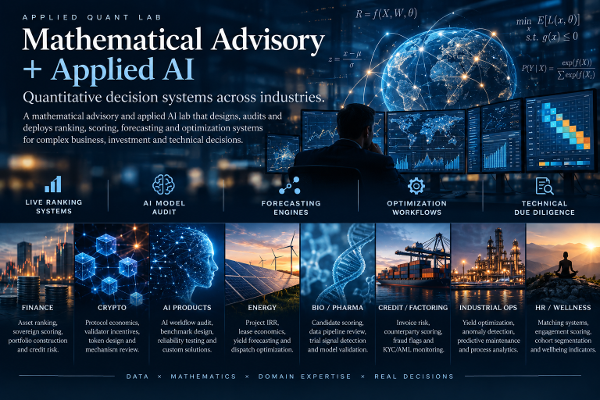
Quantitative decision systems across industries.
A mathematical advisory and applied AI lab that designs, audits and deploys ranking, scoring, forecasting and optimization systems for complex business, investment and technical decisions.
Mission
Build a cross-sector mathematical advisory platform that helps teams make better decisions when ordinary dashboards, generic AI tools and intuition are not enough.
The company is not limited to investment ranking. The same applied mathematics stack can support crypto protocol economics, credit scoring, energy project optimization, bioinformatics, industrial operations, HR matching, compliance and technical due diligence.
Core thesis
Many organizations have data, technical intuition and business constraints, but no rigorous way to turn them into repeatable decisions. Applied Quant Lab provides the math layer: model design, validation, audit, deployment and monitoring.
What We Build and Audit
Live Ranking Systems
Ranking, scoring, forecasting and optimization models for recurring decisions where rules, data and judgment must work together. View the existing ranking-system offer.
AI Model Audit
Prompt/system review, evaluation design, hallucination testing, reliability checks, workflow robustness and model governance.
Custom AI / Math Solutions
Bespoke agents, research automation workflows, extraction pipelines, dashboards and domain-specific copilots.
Simulation and Scenario Engines
Stress testing, sensitivity analysis, protocol economics, project finance scenarios and operational what-if models.
Technical Due Diligence
Independent review of technical claims in fintech, crypto, biotech, energy, industrial and AI-enabled startups.
Monitoring and Retainers
Ongoing model diagnostics, drift checks, monthly reporting and quant/AI team-on-demand support.
Initial Domains
Finance
Asset ranking, sovereign scoring, portfolio construction, factor stability and credit risk.
Crypto
Protocol incentives, validator economics, token design, consensus simulation and mechanism review.
AI Products
AI workflow audit, benchmark design, reliability testing and custom automation systems.
Energy
Project IRR, lease economics, yield forecasting, dispatch optimization and scenario stress tests.
Bio / Pharma
Candidate scoring, data pipeline review, trial signal detection and model validation.
Credit / Factoring
Invoice risk, counterparty scoring, fraud flags, KYC/AML ranking and monitoring systems.
Industrial Ops
Yield optimization, anomaly detection, predictive maintenance and process-control analytics.
HR / Wellness
Matching systems, engagement scoring, cohort segmentation and wellbeing risk indicators.
Productized Engagements
| Product | Output | Indicative Pricing |
|---|---|---|
| Model Diagnostic Audit | Review of an existing model, dataset, prompt system or scoring process; flags leakage, fragility, poor assumptions and validation gaps. | $5k-$25k |
| Model Build Sprint | Design and prototype of a ranking, scoring, forecasting or optimization system with documented assumptions and evaluation logic. | $25k-$100k |
| AI Workflow Audit | Evaluation harness, failure-mode map, accuracy/reliability review, model governance notes and improvement roadmap. | $10k-$50k |
| Technical DD Memo | Independent mathematical / technical due diligence for investors reviewing startups, protocols or model-heavy projects. | $7.5k-$35k |
| Quant / AI Team Retainer | Monthly advisory, monitoring, model updates, research automation and decision-dashboard support. | $5k-$30k / month |
Commercial Direction
Start with advisory and model-audit retainers, then productize repeatable workflows into decision dashboards and SaaS modules. For selected startups, the company can also work on an equity-for-services basis.
The wedge is trust: audit and rebuild models that already matter to the client. The platform opportunity is repeatability: turn repeated audits and builds into reusable decision engines.
Press the email address to open your email app, or send an email directly to research@midlincoln.com.