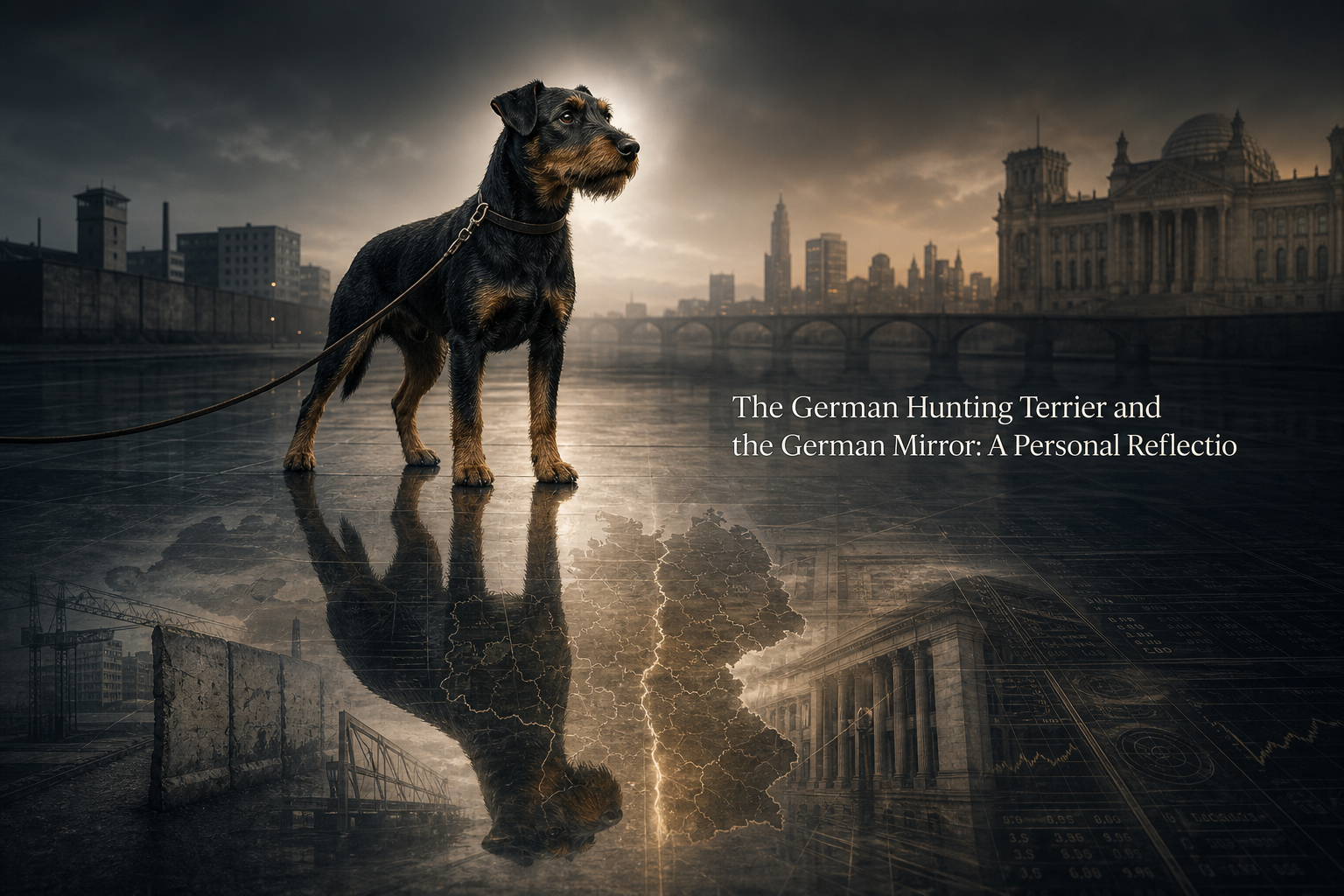
This is a personal reflection, not a political treatise. It begins with a dog.
I inherited a German Hunting Terrier—known in German as a Jagdterrier—from a fellow fund manager in exchange for three bottles of exquisite Bordeaux and Burgundy. From the moment he entered my life, I knew I had encountered something extraordinary. The German Hunting Terrier, as a breed, is the smartest dog I have ever known—possessing an independence, charisma, and emotional intelligence that rivals, and perhaps surpasses, most humans I have met. He is a best friend, full of personality.
Yet this same creature is also profoundly dangerous. His true nature is to hunt and to win fights. Anything he perceives as prey—a passing car, a lawnmower, a vacuum cleaner, or simply water falling from a roof—is subject to a sudden, intense, and terrifying attack. This is the paradox at the heart of the breed, and living with this dog has made me think about questions I never expected to consider: the relationship between instinct and civilization, between breeding and destiny, between the individual and the nation.
The German Hunting Terrier—the Jagdterrier—is not a natural creation; it is a modern breed, engineered in Germany during the 1920s and 1930s. The project was driven by a group of dedicated hunters and cynologists who wanted to create a superior hunting dog that would outperform foreign breeds, particularly the British Fox Terrier. This ambition was intertwined with a rising nationalistic sentiment in Germany between the world wars.
The key figures in the breed's creation were Walter Zangenberg, Carl-Erich Grünewald, Rudolf Frieß, and Dr. Herbert Lackner. They were experienced hunters and dog experts who possessed the resources to establish a massive breeding kennel—at one point holding up to 700 dogs.
However, the most politically connected figure was Lutz Heck, the director of the Berlin Zoo. Heck was not merely a supporter; he supplied the four foundation dogs that started the breed and was instrumental in bringing the team together.
Lutz Heck and his brother Heinz were prominent figures in the Nazi regime. They were known for their passion for genetic engineering and "back-breeding" extinct species to support nationalistic mythology. Heck counted Adolf Hitler and Hermann Göring among his friends, and his connections to power were crucial to securing resources for his projects. He was a member of the SS as a supporting member and joined the Nazi Party in 1937. Documents show he was awarded an honorary pin by the SS and lent zoo camels to the SS for fundraising campaigns.
Hermann Göring, a leading Nazi figure, was himself a passionate hunter and a close hunting companion of Lutz Heck. He was a great patron of the Berlin Zoo and helped Heck secure important positions. As Reichsjägermeister (Reich Hunting Master) and Reichsforstmeister (Reich Forest Master), Göring held ultimate authority over hunting and forestry in Nazi Germany and used his immense resources to sponsor selective breeding projects. This patronage linked the German Hunting Terrier directly to the highest levels of the Nazi hierarchy.
The Jagdterrier was conceived and developed by men who were deeply embedded in the nationalist and ultimately Nazi ideology of their time.
After World War II, Germany was split into two hostile states: the capitalist West and the communist East. Political structures were diametrically opposed. Yet, in this divided landscape, the German Hunting Terrier served as an intriguing detail. The clubs and communities dedicated to this breed persisted across the Iron Curtain. After the war, work on the breed continued independently and with different methods in the Federal Republic of Germany (FRG) and the German Democratic Republic (GDR).
In West Germany, the existing stock allowed for continued breeding along established lines, with strict selection based on working and conformation qualities. In East Germany, the breed had to be rebuilt from a few surviving individuals, with an initial priority on increasing numbers. By the mid-1960s, this led to inbreeding issues, which East German cynologists addressed through rigorous testing and culling.
The Jagdterrier, prized for its working ability, served as a point of connection—a shared heritage that even the Cold War could not fully erase. The breed was recognized internationally by the FCI in 1954, with the standard prepared by the West German club. The GDR was not a member. Yet the breed survived and thrived in both systems, a reminder of a common origin that transcended political division.
The German Hunting Terrier's nature, by design or bitter irony, mirrors a duality that has been observed in German history and culture. Whether this is merely coincidence or an irony of history, I cannot say. But living with this dog has often made me think about Germany's own historical contradictions.
On one hand, Germany is the nation of Bach, Kant, Goethe, Leibniz, Beethoven, Gauss, and Diesel—individuals of profound genius, creativity, and philosophical depth who have enriched all of humanity. This is the friendly, warm, and sociable side of the dog.
On the other hand, there is the other Germany: the Germany that initiated and lost two world wars, the Germany responsible for ethnic cleansing and industrial-scale murder. This is the warrior, the hunter that attacks anything in its sight.
These two identities, residing in the same nation, represent a profound historical duality—an uneasy coexistence of two profoundly different inheritances in a single national story. It is a harsh observation to make about a nation, but I observe this duality in my own Jagdterrier every single day, and I am constantly aware that his other identity could surface at any moment.
If my German Hunting Terrier teaches me anything, it is that powerful instincts often require constraints. Looking at post-war Germany, one cannot help wondering whether American institutions—from the Marshall Plan to KfW, from military alliances to financial ownership—have served, intentionally or not, as a comparable set of constraints.
The Kreditanstalt für Wiederaufbau (KfW) is Germany's state-owned development bank, established in 1948 by the Anglo-American occupying powers. Its creation was not simple—it emerged from inter-Allied disputes between the British and Americans over post-war German banking policy. The British proposed a "Corporation for Reconstruction Loans" in July 1947, partly as leverage in broader negotiations. The Americans initially resisted, leading to a 10-month stalemate.
The Americans took the initiative again in spring 1948, and on 2 June 1948, the Allied Bipartite Board agreed on the "Principles for a Reconstruction Loan Corporation." The German Economic Council drafted the legislation, and the law was passed on 5 November 1948. Crucially, the Germans modified the Allied principles to allow the new bank to draw on Marshall Plan counterpart funds—a change the Allies accepted. This became the KfW's primary funding source until 1960.
The US template was the Reconstruction Finance Corporation (RFC), a New Deal agency created in 1932. The Colm-Dodge-Goldsmith plan for Germany's financial rehabilitation in 1946 had proposed using the RFC as a model, but the idea was initially blocked by hardliners in the US Military Government.
The reunification that Mikhail Gorbachev and Helmut Kohl negotiated in 1990 removed the last formal constraints on German sovereignty. In July 1990, Gorbachev dropped his objection to a united Germany joining NATO, removing the last major obstacle to reunification. Gorbachev had previously insisted that a unified Germany could not be in NATO, but he ultimately conceded after Kohl agreed to billions in loans to help keep the crumbling Soviet economy afloat.
The negotiations were not merely financial. Gorbachev invited Kohl to his home in the Caucasus, a personal gesture that signaled his commitment to reaching an agreement. As Horst Teltschik, Kohl's foreign policy advisor at the time, recalled: "The fact that President Gorbachev had organized the meeting in the Caucasus, his home, was for us a sign that the negotiations would go well. You don't invite a partner to your home if you want to fight." For Gorbachev, Germany was the main route to overcoming the self-imposed isolation of past decades—he saw Germany as not only a source of economic aid but as the Western nation holding views closest to Moscow's.
In November 1990, Gorbachev visited the newly reunited Germany for the first time to sign the Treaty on Good Community, Partnership and Cooperation. The Soviet Union traded its political influence in Central Europe for a powerful new economic partnership with Germany. Kohl envisioned a treaty that would "intensify relations in all areas" and not simply "remain paper."
Yet new constraints quietly took their place. The Marshall Plan's successor institutions—KfW being the most visible—arguably became a different kind of leash, channeling American influence through financial rather than military means. Whether this continuity helps explain aspects of today's German strategic choices is a question I cannot answer. But the thread from 1948 to 1990 to the present—from KfW to reunification—is at least worth examining.
If the Marshall Plan and KfW represented the first generation of post-war constraints, one might ask whether later financial relationships—from multinational shareholdings to firms such as Cerberus—represent a modern, market-based evolution of the same phenomenon.
It is perhaps fitting that an investment firm named after Cerberus—the three-headed hound of Greek mythology who guards the gates of Hades—would appear in a discussion about leashes and institutions. Cerberus's role is not to attack indiscriminately but to prevent passage: keeping the dead from escaping and the living from entering. He is literally a guardian on a leash of order, serving a higher authority.
Whether the name carries any deeper significance is doubtful; firms often choose mythological names for their symbolism rather than prophecy. Yet the coincidence is difficult to ignore. Cerberus Capital Management has been a significant shareholder in Deutsche Bank, holding a 3% stake at various points, and has also served as an advisor to the German lender. This placed a prominent American investment firm deep within Germany's largest bank.
Cerberus has a documented history of hiring prominent Republican figures. Dan Quayle, Vice President under George H.W. Bush, joined Cerberus in 1999 and is Chairman of its Global Investments Division. John W. Snow, who served as Treasury Secretary under George W. Bush, became Chairman of Cerberus after leaving office. Brian Hook, who served multiple Republican administrations, joined Cerberus in 2021 as Vice Chairman.
Note on the Bush family connections: The relationship between George H.W. Bush and Cerberus is documented in various business and political sources, with some indicating his involvement with the firm after his presidency. This claim should be verified carefully against original documents, as readers may scrutinize it closely.
Throughout history, societies have relied on guardians—laws, alliances, banks, constitutions—to restrain instincts that might otherwise overwhelm civilization. Whether Cerberus Capital Management is one such guardian, or merely a firm with a mythological name and a significant stake in a German bank, is a question I cannot answer. The facts are available for anyone to examine. What they mean is another matter entirely.
I have learned my Jagdterrier's behavior through quiet observation. I know his tricks. I know both his sides intimately: the friendly, companionable side and the warrior side. I know that it is politically incorrect to make the connection to imply that a nation is like a dog, or to imply that Germany's other identity could emerge again. I am always aware, however, that my dog could behave in a way I cannot control. Consequently, he is constantly on a leash when I walk him. I shorten the leash when I see prey in sight.
I am not sure I want to make further connections—they are uncomfortable. But the ethical framework remains unresolved.
Immanuel Kant's Categorical Imperative is a tool for individuals, not for nations. It asks: Act only according to that maxim whereby you can at the same time will that it should become a universal law. This works for a person choosing whether to lie, steal, or betray a friend. It works less obviously when applied to a state choosing whether to invade a neighbor, subsidize an industry, or form an alliance.
If individuals are bound by the categorical imperative, what moral principle constrains states? International relations has traditionally answered with power rather than ethics. Perhaps that is why the twentieth century produced so many tragedies despite being shaped by the nation that gave us Kant.
I hope another German thinker emerges to address this paradox. The dog has made me think about it, but I have not resolved it.
Every morning I shorten my dog's leash when I see something that might awaken his instincts. I don't do it because I distrust him. I do it because I understand him.
My German Hunting Terrier has taught me that civilization is not the absence of instinct. It is the discipline to keep instinct on a leash.
A route-based system that helps users navigate concrete personal change while enabling narrow themed deployments for organizations.
View Opportunity MidLincoln OpportunityA deterministic prime-based blockchain architecture built around useful computation, cooperative verification, and post-quantum-oriented infrastructure.
View Opportunity MidLincoln OpportunityA global invoice financing and trade finance operating platform for SMEs, counterparties, and capital partners.
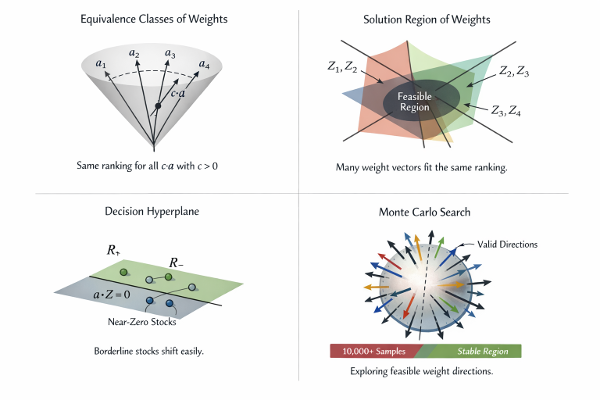
View Opportunity MidLincoln Research & AdvisoryContextual ranking research and advisory for equity selection, sovereign ranking, and model-stability diagnostics under regime uncertainty.
View Offering