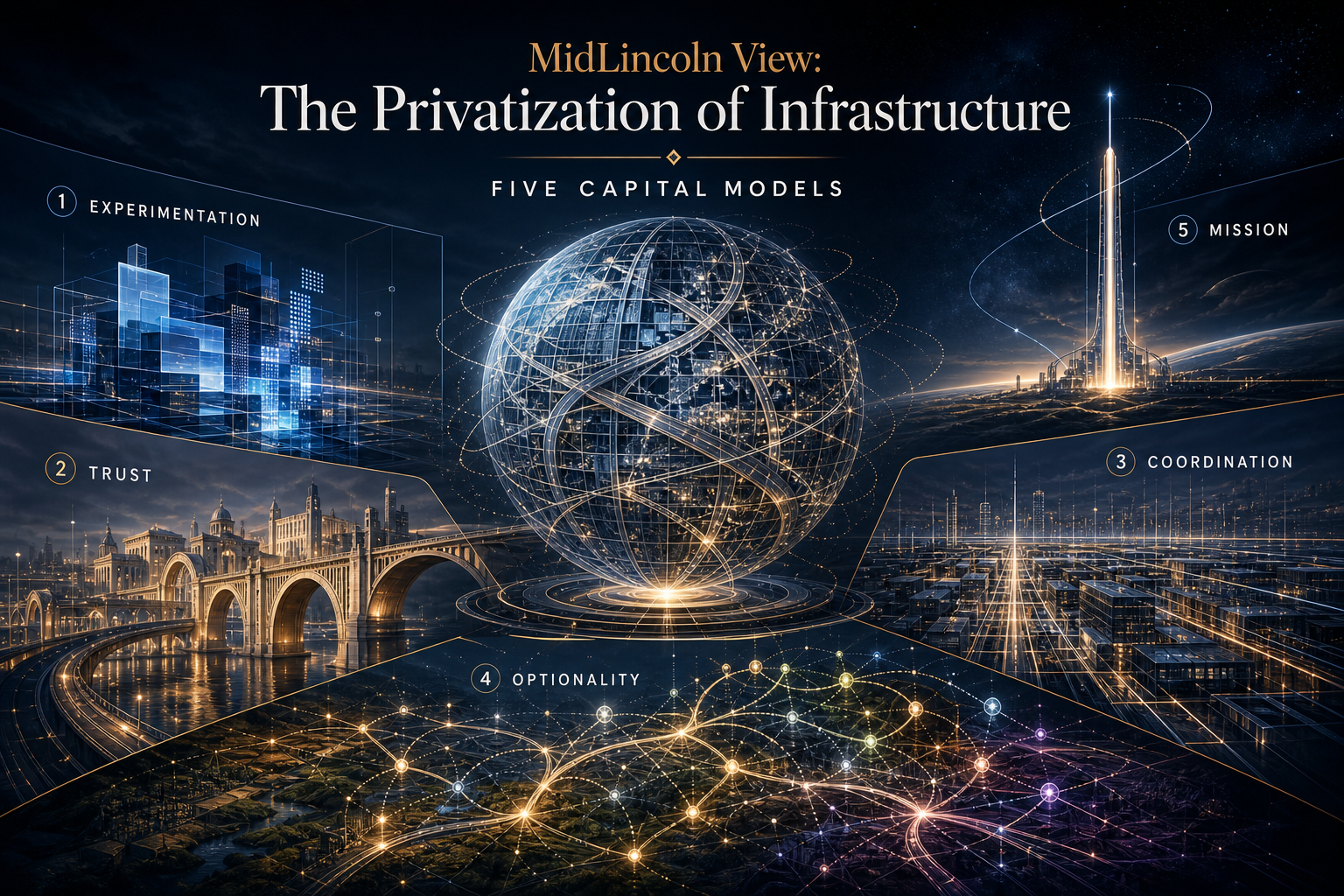
Throughout history, societies have been defined by the infrastructure they built.
Rome built roads. Britain built railways. America built interstate highways and the internet. The infrastructure of each era reflected the dominant institutions of that era—and the dominant institutions were almost always governments.
The twenty-first century may become the first era in which the defining infrastructure of civilization is financed primarily by private rather than public capital.
For most of the modern era, large-scale infrastructure required government involvement. Highways needed public funding. Power grids needed public regulation. Space exploration needed public agencies. The scale of investment exceeded private capacity, and the returns were too uncertain for private capital.
That era is ending.
Private capital now routinely builds:
The infrastructure of the future is being built less by governments and more by corporations. This has profound implications for how capital is allocated, how risk is distributed, and who controls the strategic assets of the twenty-first century.
This essay examines three domains where privatization is reshaping infrastructure: space, energy, and digital networks.
Fifty years ago, the Moon was a government project. NASA built the rockets. NASA trained the astronauts. NASA controlled the narrative. Private capital was limited to subcontracting—building components, not shaping strategy.
Today, Mars is likely to be a private project. SpaceX is building the rockets. SpaceX is developing the technology. Private capital is funding the vision.
The story is not SpaceX. The story is that governments no longer monopolize frontier investment.
Consider what private companies have achieved:
| Domain | Government Era | Private Era |
|---|---|---|
| Launch | NASA, Roscosmos, ESA | SpaceX, Blue Origin, Rocket Lab |
| Communications | Government satellites | Starlink, OneWeb, Amazon Kuiper |
| Human spaceflight | Government astronauts | Private missions, commercial crews |
| Lunar exploration | Government programs | Private landers, commercial services |
| Deep space | Government probes | Private ambitions: asteroid mining, Mars |
SpaceX succeeded because it could sustain losses, iterate quickly, and maintain a consistent vision without political interference. Government programs cannot do these things. They are subject to political cycles, budget constraints, and bureaucratic inertia.
What comes next?
Asteroid mining is likely to be private. Lunar infrastructure is likely to be private. Mars colonization, if it happens, is likely to be private.
Private companies can take risks that governments cannot. They can sustain losses in pursuit of long-term goals. They can experiment, fail, and iterate. They are accountable to shareholders, not voters, which means they can prioritize long-term value over short-term politics.
What does this mean for capital allocation?
Three implications.
First, space is becoming an investable sector rather than a government program. Satellite communications, launch services, lunar infrastructure, and defense technologies will increasingly be funded by private markets rather than public budgets.
Second, the economics of space are changing. Reusable rockets reduce costs. Starlink generates revenue. Starship opens new possibilities. The business case for space is improving rapidly.
Third, the risk profile of space is shifting. Private companies can bear risk differently than governments. This changes what is possible—and what is profitable.
SpaceX's eventual IPO—if and when it comes—will represent the transition of space from government expenditure to a commercial asset class. The IPO itself matters less than what it symbolizes: that the final frontier has become an investable frontier.
Energy infrastructure is undergoing a similar transformation.
For most of the twentieth century, electricity generation, transmission, and distribution were considered natural monopolies. Governments regulated them heavily. Public utilities dominated. Private capital was limited to equipment manufacturing and fuel extraction.
That model is breaking down.
Three forces are driving the privatization of energy infrastructure:
First, decentralization. Solar panels on rooftops, batteries in garages, and electric vehicles that can store and discharge power are shifting energy from a centralized system to a distributed one. The grid is no longer a one-way street; it is a network of producers and consumers.
Second, technology. AI can optimize grid operations. Software can balance supply and demand. Smart meters can enable dynamic pricing. The physical infrastructure is being overlaid with digital intelligence.
Third, capital. The scale of investment required for the energy transition—trillions of dollars globally—exceeds what governments can provide. Private capital is filling the gap.
But there is a deeper shift: energy has become software.
The value is moving from copper to code.
Grids are being optimized by AI. Virtual power plants aggregate distributed resources. Dynamic pricing balances supply and demand. Smart meters enable real-time optimization. The infrastructure is becoming intelligent.
This is a profound transition. The energy system of the future will look more like the internet than like the grid of the twentieth century. And like the internet, it will be built and operated primarily by private capital.
What does this mean for investors?
Four implications.
First, energy infrastructure is becoming an asset class. Wind farms, solar arrays, battery storage, transmission lines, and charging networks are all attracting private capital. The returns are stable, predictable, and increasingly competitive.
Second, technology companies are entering energy. Google, Amazon, Microsoft, and others are investing in renewable energy to power their data centers. They are becoming energy companies by necessity.
Third, traditional utilities are being disrupted. Decentralized generation, storage, and demand response are reducing the value of centralized infrastructure. The utilities that adapt will survive; those that don't will decline.
Fourth, geopolitical risk is increasing. Energy infrastructure—pipelines, grids, critical minerals—is becoming a strategic asset. Private investors must consider not just economics, but politics.

The internet began as a government-funded research project.
It became a commercial enterprise.
It is now critical infrastructure.
Digital networks—data centers, undersea cables, satellite constellations, cloud infrastructure—are as important to modern economies as roads, bridges, and power grids were to the twentieth century.
But unlike traditional infrastructure, digital networks are almost entirely privately owned.
Consider what private companies have built:
| Asset | Built By | Scale |
|---|---|---|
| Global cloud infrastructure | Amazon, Microsoft, Google | Trillions of dollars |
| Undersea cables | Consortia of telecom companies | Hundreds of thousands of miles |
| Data centers | Private companies | Millions of square feet |
| Satellite internet | SpaceX, OneWeb | Global coverage |
| Mobile networks | Private telecom companies | Billions of users |
This represents a fundamental shift in the ownership of critical infrastructure.
But there is something more important happening.
Data centers are no longer just cloud infrastructure. They are becoming the factories of intelligence.
AI requires enormous computing power. Training large language models requires clusters of thousands of specialized chips. Inference requires real-time processing at scale. The infrastructure of AI is not just software; it is hardware, energy, and physical space.
The companies that build the factories of intelligence—data centers optimized for AI, chips designed for machine learning, networks capable of moving vast amounts of data—will be the infrastructure companies of the twenty-first century.
What does this mean for investors?
Three implications.
First, digital infrastructure is a growth sector. Data centers, cloud computing, satellite networks, and cybersecurity are all expanding rapidly. The companies that build and operate these assets will generate substantial returns.
Second, digital infrastructure is becoming strategic. Governments are increasingly concerned about who controls data, communications, and computation. This will lead to regulation, but also to opportunities for private companies that can provide secure infrastructure.
Third, the convergence of digital and physical infrastructure is accelerating. Smart grids, autonomous vehicles, connected factories, and AI-powered cities require both digital and physical assets. The companies that bridge these domains will create significant value.
The privatization of infrastructure creates a tension that investors must understand.
On one hand, private capital is more efficient.
Private companies can make decisions faster. They can sustain losses longer. They can take risks that governments cannot. They are accountable to shareholders, not voters, which means they can prioritize long-term value over short-term politics.
On the other hand, private infrastructure creates a profound question: who owns civilization?
Consider what is now privately owned:
The strategic assets of the twenty-first century are increasingly owned by private investors, not public institutions.
This is not inherently good or bad. It is simply new.
For most of history, the strategic assets of civilization—roads, ports, power grids, communications networks—were owned or controlled by governments. Today, the most important infrastructure is privately owned. The question is whether this creates new risks that investors must understand.
What should investors watch?
Three things.
First, regulation. Governments will inevitably seek to regulate privatized infrastructure. The form and intensity of regulation will determine returns. Light regulation will favor investors; heavy regulation will favor consumers.
Second, national security. Critical infrastructure—space, energy, digital networks—will increasingly be viewed through a national security lens. This will create opportunities for companies that can provide secure infrastructure and risks for those that cannot.
Third, monopoly power. Privatized infrastructure can become monopolistic. Investors must consider antitrust risk, especially in digital networks where scale creates natural advantages.
There is a deeper story here.
The privatization of infrastructure represents a shift in the balance of power between public and private sectors.
For most of history, governments built the future.
Governments funded exploration. Governments built infrastructure. Governments managed strategic assets. Governments took the long view because they had to.
Today, private companies are increasingly building the future.
Private companies are exploring space. Private companies are building energy infrastructure. Private companies are operating digital networks. Private companies are taking the long view because they can afford to.
This is not a minor change. It is a structural shift in how capital is allocated, how risk is distributed, and who controls the strategic assets of the twenty-first century.
The future is being built by investors.
Let us summarize the shift:
| Domain | Old Model | New Model |
|---|---|---|
| Space | Government programs | Commercial asset class |
| Energy | Regulated utilities | Private infrastructure |
| Digital | Public research | Critical private infrastructure |
| Risk | Taxpayer bears risk | Investor bears risk |
| Control | Public sector | Private sector |
| Capital | Government budgets | Private markets |
The privatization of infrastructure is not a political choice. It is an economic necessity.
The scale of investment required for the twenty-first century—space exploration, energy transition, digital networks, climate adaptation—exceeds what governments can provide. Private capital must fill the gap.
But this creates a new question: Who controls the strategic assets of the future?
The answer will determine not only where capital flows, but the balance of power between public and private sectors for generations.
Every industrial revolution has been defined by the infrastructure it created. Canals shaped the eighteenth century. Railways shaped the nineteenth. Highways and electricity shaped the twentieth. The infrastructure of the twenty-first century is digital, distributed, intelligent—and increasingly private.
Investors are no longer simply financing businesses. They are financing the architecture of civilization itself.
— MidLincoln View
This essay is the fourth in a four-part series on the forces reshaping global capital allocation. The first essay examined five competing models of capitalism. The second examined macro cycles. The third explored the economics of wellbeing.
Series Complete: The Next Decade — Four Essays on the Forces Reshaping Capital
A route-based system that helps users navigate concrete personal change while enabling narrow themed deployments for organizations.
View Opportunity MidLincoln OpportunityA deterministic prime-based blockchain architecture built around useful computation, cooperative verification, and post-quantum-oriented infrastructure.
View Opportunity MidLincoln OpportunityA global invoice financing and trade finance operating platform for SMEs, counterparties, and capital partners.
View Opportunity MidLincoln Research & AdvisoryContextual ranking research and advisory for equity selection, sovereign ranking, and model-stability diagnostics under regime uncertainty.
View Offering