. | |||
Sneakers Revolution.
Russia - is not calm and is in search of New Balance
What happened on Sunday in Moscow and in all other major cities in Russia was pretty spectacular, thousands of teenagers 14-16 years old most of them wearing sneakers turned up for a banned protest. More than a thousand of them were arrested. The keynote feature was that they knew that the protest was banned, but it had not stopped them and they turned up anyway.
Following the 2011 unrest and subsequent witch hunt, the opposition in Russia was crushed. Anybody who was openly in opposition in Russia had to either tone down the pitch or leave the country if they were allowed to. It was quite obvious that the event advertised by Alexey Navalny the leader of Russian opposition would be poorly attended on Sunday. A hoard of teenagers who went for a walk on Sunday night in downtown Moscow, St.Petersburg, Samara, Novosibirsk and Rostov on Don had surprised many.
The authorities immediately produced the expected - that the teenagers were somehow financially motivated but there is no doubt that most of them still jailed are being tortured with questions to disclose their reasons for attendance of Sunday protests.
We agree, that the financial motive may be the key. But the reasoning could be at least slightly more complex. As latest consumption indicators point out - families in Russia are struggling on a day to day basis to meet their ends. Disposable incomes record at least c. 4% drop in real terms and this is assuming inflation recorded for Russia consumption basket. While inflation of prices for imports would probably shrink the disposable incomes to 50%. The important part of teenagers outfit are a shiny pair of sneakers. But a new pair of sneakers is roughly 10000RUB at a New Balance, Adidas or a Nike store in Moscow (sorry to use the brand names here). This is roughly 25% of monthly Russian GDP/Capita which stands at 722$ this year and almost a third of average Russian wage of 36000Rub/month.
Of course the reasons for protests are far more complex but the simplistic explanation for teenagers showdown in downtowns that they understand what’s going on with their parents budgets and consciously looking for ways to solve problems.
And who can stop the roaring teenager?
While many thought that the upcoming 2018 election would be a non-event with pretty predictable outcome, these ideas are only partially true.
Of course most watchers had expected the protests. But they had not expected them to occur so early in pre election run up.
Unlike in 2011 when the oil price stood at 120$/boe, it is quite evident that the opposition is pretty much alive and has probably gathered more supporters as incomes dried up and oil fortunes vanished.
An open opposition had of course stepped back. But it would be difficult to argue that the power now has more supporters than in 2011.
The question is how would the markets react.
The election years are generally profitable for investors who go long before the vote and sell after.
When to buy - now? Or wait for lower levels.
We take the naive view as we don’t think that the protests will have a negative impact on the markets if their goal is to drive economic improvement if political change will be small.
If however the toll for political change will be large - the markets will have to price in additional risk, and there will be more likely lower levels ahead where larger positions could be build.
Russia economic growth is slowly getting closer to positive numbers. Industrial production has been in a growing mode since summer of 2016. The real wages are growing while retail sales decline headline numbers are less and less negative, but the recovery looks fragile and is unlikely to be V-shaped.
Unlike in 1998 when Russia had lavish excess of unutilized capacity and unlike in 2008 when restocking and quick bounce in oil price provided support for Russian economy, the current crisis has a much fewer options for policy to maneuver.
Russian Capacity Utilisation (Goskomstat)
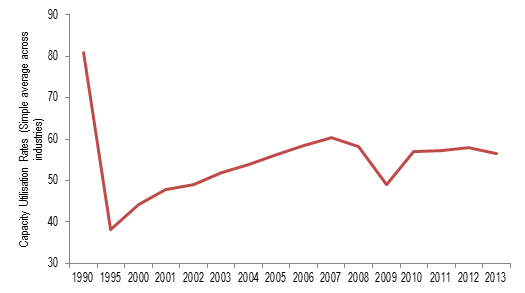
Sanctions and devaluation provided some protectionist advantage to the economy, but they were quite short lived as capacity utilization rates are at post-Soviet maximums while scarcity of capital and high risk would not allow any sizeable capacity expansion.
Oil prices have also been unsupportive and are now seen in a very long sideways trend and perhaps trending lower.
Policy makers mentioned several remedies for economic reversal citing possible increases in infrastructure improvement programs, expansion of local credit as well increases in productivity.
In each of the later 3 areas expansion may occur from a very low base and could be quite helpful in improving the economy.
But the improvement in productivity is the key in our view: In the last 10 years Russians had to work more to produce less as small population increase occurred on the back of stagnating oil production.
Russian Productivity Dynamics (Goskomstat)
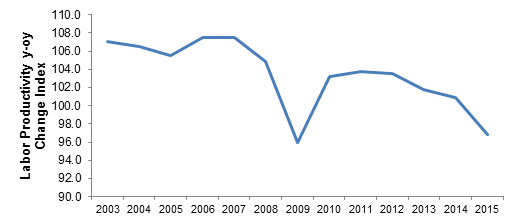
Productivity improvement is unlikely - unless Russia uses the same labor principles, and methods, treats private property and uses law in the same way as leading economic powers of east and the west ie. Singapour, Hong Kong, Taiwan, Japan, and the remaining G7. But that can require expensive for current elites political tweeks to make the change.
Perhaps we are being naive but we think that the current economic conditions should stimulate a notable shift to true liberal policies. But the authorities need to take red pill in order to see where improvement is needed to preserve and to improve whatever they had built in 20 years.
If they take the blue pill - it can all end in tears, in a year celebrating 100 years of changes in Russia.
The showdown on the streets of Moscow on Sunday and in many other Russian town were most likely stimulated by parents who are quite afraid to go outside and protest openly, but can risk to send their kids (hoping for their immunity due to minor age), hoping that this can be their small donation which could lead to a economic and possibly political change.
So a typical Moscow mother - when confronted by her teenage daughter begging for a new pair of air max 95 sneakers - would send ker kid outside on the street - with a wording: You want yourself new pair of shoes - go walk downtown tonight. Just do it!
In many other households kids are smart, mature and can figure out themselves what to do to help their folks.
Ovanes Oganisyan